Swiss Account: A Guide to Choosing and Opening a Current Account
A Swiss Account is the cornerstone of managing your finances effectively in Switzerland. Far from being just a place to keep money, it’s the practical key to your daily financial life – essential for receiving your salary, paying rent and bills, and using essential local payment systems.
This comprehensive guide will walk you through everything step-by-step. We’ll start by breaking down the main types of accounts available, then cover why a Swiss Current Account is essential and explain the key features you need (E-Banking, QR-Bills, eBill and TWINT). We will then compare the banks themselves (traditional vs. digital), analyze the key costs, detail the opening process, and conclude with our smart strategy verdict. By the end, you’ll have the confidence to navigate the Swiss banking system and make the smartest choices for your financial needs.
Understanding the Main Types of Accounts Available
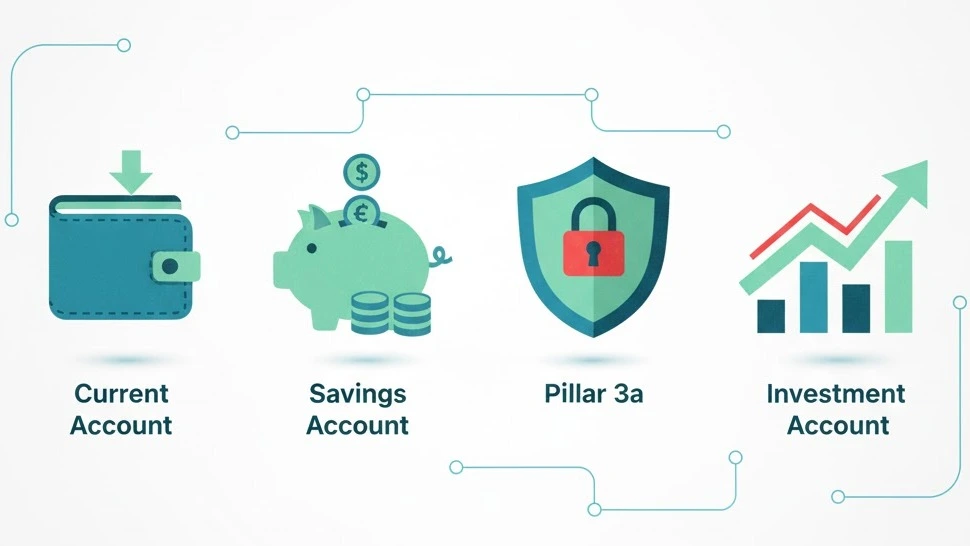
The Swiss banking system offers several different types of accounts for your personal financial needs. While this guide will focus primarily on the Current Account (your main transaction account), it’s essential to understand the other products you’ll encounter. We list the main types here for a complete overview:
- Current Account: This is your main transaction account. It’s the central hub for all the daily financial activities we mentioned in the introduction.
- Youth/Student Account: This basically offer the same functions as a Current Account but is often completely free for students or people under a certain age (usually 25 or 30).
- Savings Account: This is designed for your savings. Unlike your Current Account (which pays almost zero interest), a Savings Account offers a slightly higher interest rate. The trade-off is that it’s not for daily use, as banks enforce monthly or annual withdrawal limits.
- Pillar 3a Account: This is a powerful, tax-privileged retirement account for anyone working in Switzerland. Given its importance, we explain it fully in our Pillar 3a Guide.
- Investing Account: This is a separate account designed specifically for investing in assets like stocks, ETFs, and funds. It’s focused purely on building wealth.
We’ve listed these account types separately for clarity. In practice, they often coexist within a single bank’s ecosystem.
The Current Account is the foundation for all your daily transactions. A bank will then typically offer you their other products, like a Savings Account, a Pillar 3a Account, or an Investment Account, as optional add-ons to build out your financial setup.
While it can be convenient to have everything in one place, remember that you are never obligated to get all your products from the same bank. In fact, it’s always possible to combine products from different providers to maximize your benefits and savings.
Why a Swiss Current Bank Account is Essential
A Swiss Current Account with a unique CH-IBAN is essential for your daily financial life in Switzerland. You will need it for these non-negotiable, everyday transactions:
- Receiving Your Salary: Virtually every Swiss employer requires a CH-IBAN to pay you.
- Paying Your Rent: This is your largest fixed expense, almost always paid via bank transfer.
- Paying All Other Bills: Your account is essential for paying all other non-rent invoices, such as utilities, phone bills, and health insurance.
- Using Essential Swiss Apps: Your account is the key to accessing local tools like TWINT and eBill.
- Getting a Swiss Debit Card: It provides you with a debit card for daily purchases and ATM access (Bancomats).
Essential Features for Modern Banking in Switzerland
It’s crucial to understand what a modern Swiss Current Account actually does for you. The true value of your account is defined by its essential features. Think of your bank as your hub for daily transactions; how well this hub integrates with the following local systems will determine your day-to-day convenience and efficiency.
E-Banking & The QR-Bill System
Think of your E-Banking (via browser or mobile app) as your digital command center. You will use it for all key actions: checking your balance, making transfers and paying your bills.
In Switzerland, paying bills means interacting with the QR-bill. This is the legal standard for all invoices and is designed to make payments simple and error-free. The bottom part of your bill features a large QR code that contains all the necessary payment information: the recipient’s IBAN, the exact amount, and the complex reference number.
Your E-Banking app is what makes the bill’s payment process so simple. You just scan the QR code with your phone’s camera, and the app automatically fills in all the payment details. This saves you from typing everything manually and, most importantly, prevents costly payment errors.

eBill
While scanning QR-bills is simple, eBill is the fully automated upgrade and the modern standard for paying bills in Switzerland. It’s a digital billing portal that you access directly from within your E-Banking. Instead of receiving a paper QR-bill or a PDF invoice via email, eBill delivers your bills securely and electronically into this portal, ready for your approval.
It’s considered essential by most residents for several key reasons:
- Centralized Control: All your bills from different companies are collected in one single eBill dashboard within your E-Banking portal. This means you never risk losing a paper bill or overlooking an email invoice.
- One-Click Payment: All bill details (amount, reference number, due date) are pre-filled automatically. There is no need to scan QR codes or type anything manually. You simply review the attached PDF bill and approve the payment with a single click.
- Total Payment Flexibility: You are always in control. When a new eBill arrives, you can:
- Approve it for immediate payment.
- Schedule the payment for a future date (e.g., the bill’s due date or your payday).
- Reject it with one click if the bill is incorrect or you don’t recognize it.
- Smart Automation: For trusted, recurring bills you can set up Standing Approval. This allows the bank to pay these bills automatically. You can even set rules, such as, “Automatically approve all bills from Swisscom as long as they are under 150 CHF.”
To start using eBill, you must subscribe to each biller (e.g., your telecom provider, your health insurer) one time. You do this from within your eBill dashboard by searching for the biller’s name and registering, usually using a customer ID found on an old paper bill. After that, all future bills from that company will arrive digitally.
TWINT
This app is practically essential for daily life in Switzerland. It functions as a digital “layer” that sits on top of your bank account, allowing you to:
- Send or receive money: transfer funds to anyone using just their mobile phone number as the identifier.
- Pay in stores by scanning a QR code.
- Shop online at most Swiss e-commerce sites.
- Pay for parking in many Swiss cities and many other minor use cases.
The best part is that, being directly linked to your bank account, all these transactions are typically instant and fee-free for you as the user. This convenience is why it has become the common practice for paying friends or for private sales (like on tutti.ch or Ricardo).
Given its importance, the ability to link TWINT directly to your bank account is a fundamental feature. Most Swiss banks, both digital and traditional, offer this.

Choosing Your Bank: Traditional vs. Swiss Neobanks vs. International Services
Okay, this is the big decision: choosing the right bank for your Current Account. As a resident in Switzerland, you have three main categories of providers to choose from, each with very different pros and cons.
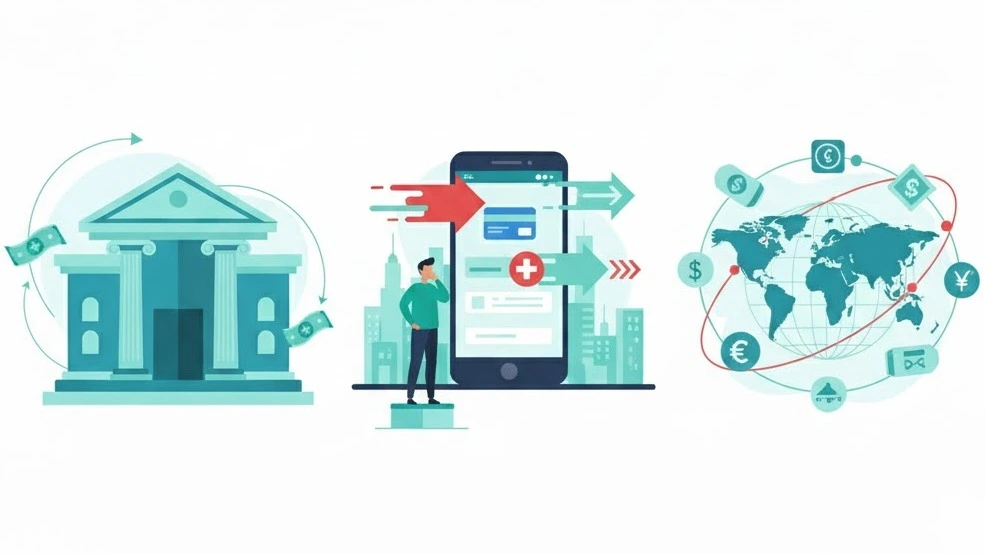
Traditional Banks
These are the big, established names with branches on nearly every high street, such as UBS, the Cantonal Banks (e.g., Zürcher Kantonalbank), Raiffeisen, and PostFinance.
- Pros
- In-Person Support: They provide physical branches, which is crucial for complex issues or for those who prefer face-to-face interaction over digital support.
- Full Range of Services: They offer a complete financial ecosystem, including mortgages and complex wealth advice.
- Long-Established Brand: Their history and brand recognition provide a strong sense of security and stability.
- Cons
- Higher Costs: This is their main drawback, usually come with higher costs compared to neobanks. Always check their fee schedule carefully.
Swiss Neobanks
These are the modern, app-based Swiss banks built for the digital age, such as Neon, Yuh , and Zak.
- Pros:
- Low-Cost Model: Their primary advantage. Daily banking is often completely free (no monthly fees, free debit card).
- Fast Digital Onboarding: The process is 100% app-based and consistently fast, often completed in minutes.
- Excellent App & FX Rates: They provide modern, user-friendly apps with powerful features (like investing, savings tools) and far better foreign exchange (FX) rates than traditional banks.
- Full Swiss Integration: They provide a proper CH-IBAN and seamless, direct integration with local systems like TWINT and eBill.
- Cons:
- No Physical Branches: This is the core trade-off. All customer support is handled via app, email, or phone, not in person.
- Limited Service Range: Their focus is on daily banking, payments, and simple investing. You typically cannot get complex services like a mortgage or in-person wealth advice.
International Neobanks
This category is led by powerful international fintech apps, with Revolut being the most well-known example. These services are globally popular, attracting millions of users thanks to their slick mobile apps, excellent currency exchange rates, and powerful multi-currency features.
- Pros
- Low-Cost Model: They offer extremely competitive pricing, often with free standard plans.
- Fast Digital Onboarding: The process is 100% app-based and very fast, often completed in minutes.
- Excellent App & FX Rates: They are famous for feature-rich apps, easy multi-currency management, and some of the best possible interbank exchange rates for spending abroad.
- Cons:
- No Physical Branches: Like Swiss Neobanks, they are digital-only, so all support is handled internationally via app or email.
- Limited Service Range: Their focus is on daily banking, payments, and simple investing. You typically cannot get complex services like a mortgage or in-person wealth advice.
- Incomplete Swiss Integration: This is their main drawback and a key point of distinction.
- The IBAN: The situation here is mixed. Some providers (like Revolut) now offer a CH-IBAN which is a huge advantage for receiving a salary and local payments. However, many other international fintech competitors do not, providing only a European IBAN (e.g., DE, LT…), which can be problematic.
- Missing Local Systems: Even providers that do offer a Swiss IBAN still lack support for essential local systems like eBill and direct TWINT integration, although a workaround exists for the latter.
- Global Focus: Their primary focus remains global. This can affect customer support and the development of features specific to the Swiss market.
TWINT Workaround Explained
The most common workaround involves using the separate “TWINT Prepaid” app. You can load funds onto this app using your International Neobank debit card, allowing you to make TWINT payments from that prepaid balance. However, this requires manually topping up the TWINT app, unlike the direct-from-account payments offered by Swiss banks.
Key Costs to Compare When Choosing
This is where you can save the most money. Look past the brand name and compare these fees line by line.
A crucial note: The models we describe below are the standard “default” offerings for Traditional Banks and Neobanks. However, the market is dynamic, and specific offers, fees, and conditions can vary significantly by provider and even by the specific package you choose.
We strongly recommend using these points as your checklist and always verifying the official, up-to-date fee schedule of the bank you are considering before you sign up.
Monthly Account & Debit Card Fees
Neobanks typically offer a free model, which includes both account maintenance (no monthly fees) and an associated debit card at no extra cost.
Traditional banks usually charge a monthly package fee (e.g., 5-15 CHF) that bundles both services. In many cases, this fee is waived or reduced if you meet certain criteria (like maintaining a high account balance).
Be careful, however: it is not guaranteed that this monthly fee also includes a free debit card, which may carry a separate fee.
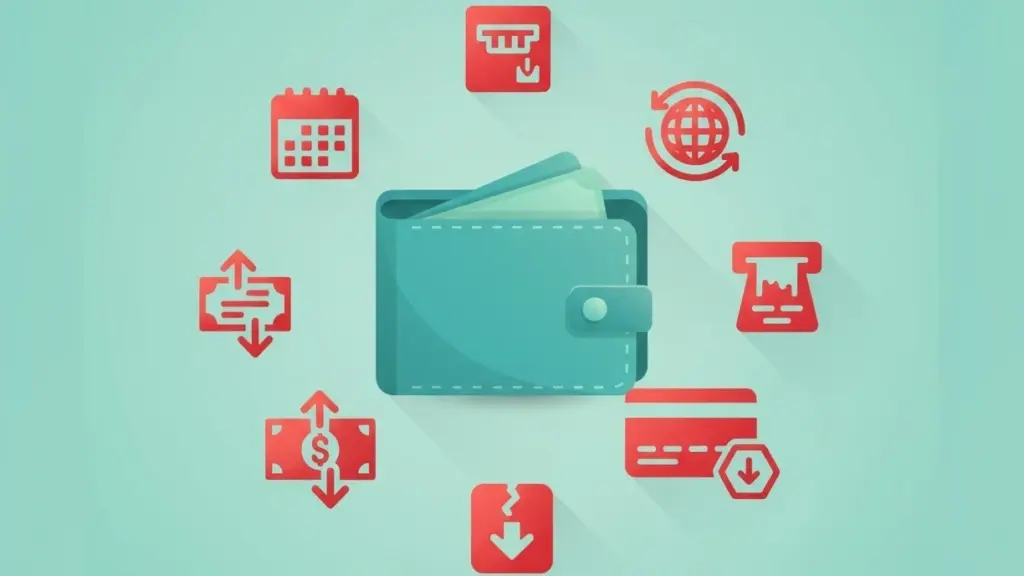
ATM Withdrawal Fees
The cost of withdrawing cash differs significantly based on the bank’s business model.
Traditional Banks build their model around their own large ATM network.
- Own ATMs: Withdrawals are almost always free.
- Other Swiss ATMs: They heavily penalize withdrawals at other banks’ machines (e.g., 2-5 CHF per withdrawal).
- Abroad: This is a major cost trap, often involving a high fixed fee plus a significant currency exchange markup.
Neobanks have no (or a very limited) ATM network, so their model is different.
- Swiss ATMs: They often offer a set number of free withdrawals per month at any ATM.
- Abroad: They are far cheaper, using excellent exchange rates with low or no commissions, often up to a certain monthly free withdrawal limit.
Foreign Transaction Fees
When you buy something online in EUR, USD or other currencies, or travel to another country, how much extra are you paying? Look for two things:
- Exchange Rate Markup: Does the bank use the low “interbank” rate or do they add their own 1.5-3% markup?
- Fixed/Percentage Fees: Do they add an additional commission on top of the transaction?
Neobanks are almost always the clear winners here, as they typically charge zero (or very low) commissions and use near-interbank exchange rates.
Bank Transfer Fees
The cost of sending money depends entirely on what you are sending and where. It’s crucial to distinguish between three types of transfers:
National Transfers (in CHF): Payments made in Swiss Francs to another Swiss bank account are almost universally free when initiated via e-banking, for both traditional and neobanks.
SEPA Transfers (in EUR): Transfers in Euros to other SEPA-zone countries (like Italy, Germany, France, etc.) are also typically free with most Neobanks and services like Revolut. Most Traditional Banks now offer free SEPA transfers via e-banking as well, but it’s always worth checking their fee schedule.
International SWIFT Transfers (in USD, GBP, etc.):This is the critical difference and a major cost trap.
- Traditional Banks: Are often very expensive. They typically charge a high fixed fee plus a poor exchange rate, which includes a hidden “markup”.
- Neobanks: Are the clear winners here. They use near-interbank exchange rates and charge only a small, transparent percentage fee, making them vastly cheaper for sending money internationally.
The Credit Card Cost Trap
While a debit card is directly linked to your Current Account and spends money you already have, a credit card is an optional, separate product. It is not linked to your account balance; instead, it provides you with a pre-approved credit limit (e.g., 5,000 CHF) based on a “buy now, pay later” model. The card issuer pays for your purchases and sends you a single, consolidated bill at the end of the month. You can then pay this bill in full to avoid interest, or pay only a portion, which is when you will be charged high interest (often over 10%) on the remaining unpaid balance.
This distinction is key because traditional banks often bundle an optional credit card with their packages, which may be free for the first year but then carries a high annual fee (e.g., 50-200+ CHF).
Neobanks typically don’t offer traditional credit cards. This leads to the Smart Strategy: get your free neobank account for daily use and, if you need it, apply for a separate, no-annual-fee Swiss credit card from a dedicated provider.
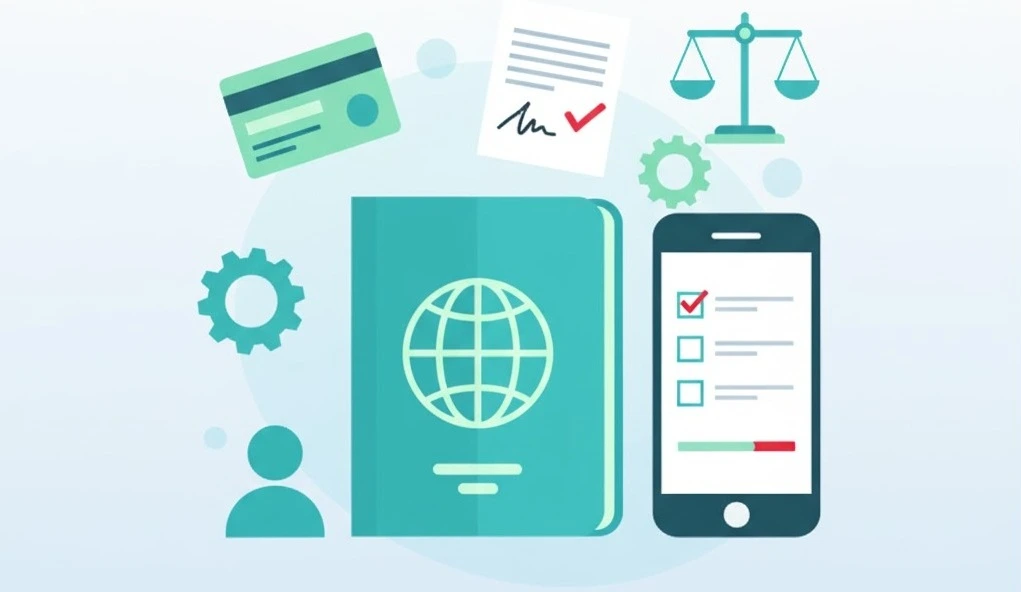
What You Need to Open an Account
The account opening process in Switzerland is straightforward, but the specific documents required depend entirely on your residency status.
For Swiss Citizens, the process is very simple. You will typically only need a valid Swiss ID card or Passport. Some banks may also ask for a proof of address (like a utility bill) if it’s not on your ID.
For Non-Swiss Residents (EU/EFTA or Third-Country), you will generally need some documents:
- A Valid Passport or EU/EFTA ID Card.
- Your Swiss Residence Permit (e.g., Permit B, C, or L).
- An Employment Contract may sometimes be requested to prove your economic link to Switzerland, though this is less common with neobanks.
For Cross-Border Commuters (Permit G), who work in Switzerland but live in a bordering country, opening a Swiss account (often required for your salary) is also possible. You will typically need your Passport/ID and your G Permit.
An Important Note for US Citizens (FATCA): If you are considered a “US Person” for tax purposes, you are legally required to declare this and fill out a W-9 form due to US FATCA regulations. All Swiss banks will ask this; it’s a standard, non-negotiable part of the process.
Opening a standard Current Account as a non-resident (with no work or property ties to Switzerland) is extremely difficult, often very expensive, and not possible with most of the banks discussed in this guide.
The Smart Strategy Verdict
So, what’s the best move? Here’s our recommendation.
For Your Main Daily Account the best value is almost always a Swiss Neobank. But don’t just pick one at random. Choose the provider that offers seamless, direct integration for both TWINT and eBill and has a clear, low-cost structure. This approach gives you all the essential local features while saving you the most money.
Revolut as a “Must-Have” Complement: For anyone who travels frequently, manages multiple currencies, or simply wants access to some of the best possible exchange rates, Revolut is practically a must-have.
When Might a Traditional Bank Still Be the Best Fit? While Neobanks excel at daily banking, Traditional Banks remain the primary choice for certain specific needs. The most common reasons to opt for a traditional bank include Complex Financial Advice and Physical Branch Services.
Ultimately, the “best” Swiss private setup is the one that fits your personal needs. This Smart Strategy Verdict isn’t a rigid rule, but a powerful framework. You now have the knowledge to analyze your own needs and confidently build the smart, low-cost financial setup that works perfectly for you.